
Last checked: 18 October 2026 · Search steps tested on the live UDGAM portal
Quick answer: You can search for unclaimed bank deposits across about 30 banks, for free, on RBI’s UDGAM portal (udgam.rbi.org.in). Registration and a search take about 10 minutes. UDGAM only finds the deposit; to get the money, you claim it at the bank, which pays it with any interest due.
What counts as an unclaimed deposit?
Money in a savings or current account that has not been operated for 10 years, or a fixed deposit not claimed for 10 years after it matured, is treated as unclaimed. Banks transfer these amounts to RBI’s Depositor Education and Awareness (DEA) Fund.
The money is not lost. The account holder, nominee or legal heir can claim it from the original bank at any time. The bank pays you, along with interest on interest-bearing deposits, and then gets reimbursed by RBI.
Who this guide is for
- Account holders who think they may have an old, forgotten account or fixed deposit
- Nominees claiming the deposit of someone who has died
- Legal heirs (where there is no nominee) tracing a parent’s or relative’s money. See the legal heir section below for the extra steps.
Before you start: keep these ready
- Your own mobile number, for registration and OTP
- The full name of the account holder, spelt as it was likely recorded by the bank
- At least one more detail of the account holder: their old address (area or city and state), or a unique ID such as PAN, date of birth, passport, voter ID or driving licence
- Old passbooks, FD receipts or bank letters, if you have them. They help at the claim stage
Step-by-step: how to search on UDGAM
- Open the official portal at udgam.rbi.org.in. Check that the address bar shows rbi.org.in. There is no fee and no app to download.
- Register with your name, your mobile number and a password, then verify with the OTP sent to your phone.
- Log in with your mobile number, password, the captcha and the OTP.
- Choose the “Individual” tab (use “Non-Individual” for a company, trust or society). Enter the name of the account holder (or joint account holder) and select the banks. Use the dropdown to select all banks.
- Add at least one more search detail. By default the form asks for an address: a building, street, area or city, plus the State/UT. To search by a unique ID instead, tick “Search with unique parameters” and enter details such as PAN, date of birth, passport, voter ID or driving licence. More details give more accurate matches.
- Search and read the results. A match shows the account holder’s name, the bank, a link to the bank’s website, the address on record and a UDRN (Unclaimed Deposit Reference Number).
- Note down the UDRN and bank name, or take a screenshot. You will need them when you approach the bank.
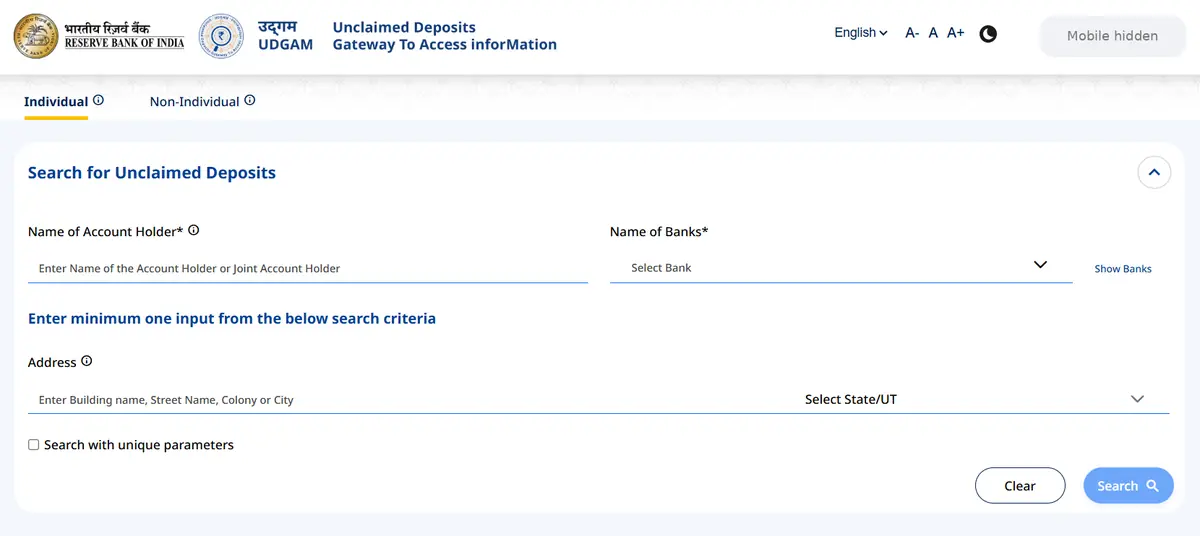
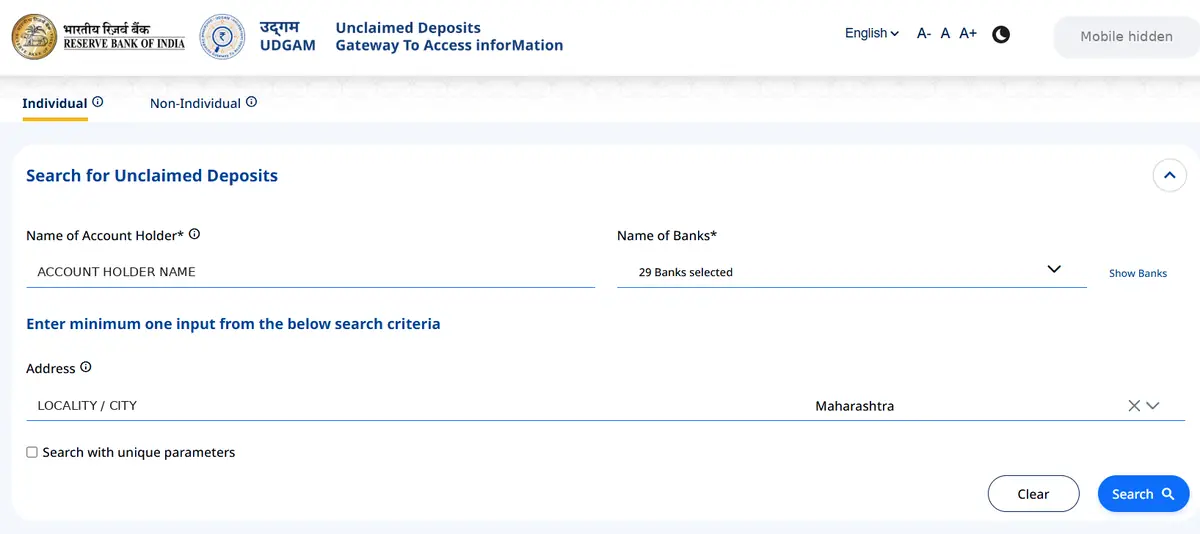
Tip: try spelling variations of the name (with and without initials or middle names) and repeat the search with different addresses the person lived at, or with unique IDs. Old records are often entered differently. For an older address, try just the area and city with the state selected.
After you find a match: claiming the money
- Contact the bank shown in the result. Visit any branch, ideally the one where the account was held, or follow the claim instructions on the bank’s unclaimed deposits page.
- Fill the bank’s claim form and quote the UDRN.
- Submit KYC documents: identity and address proof and a recent photograph. Nominees and legal heirs need more documents (see below).
- The bank verifies and pays the amount, with interest where applicable, or reactivates the account if you are the account holder.
Settlement time varies by bank and depends on how complete your documents are. Claims by the account holder are usually the quickest; claims by legal heirs take longer.
If you are a nominee or legal heir
- Nominee registered: the nominee usually needs the death certificate of the account holder, their own KYC documents and the bank’s claim form.
- No nominee: banks ask for proof that you are the legal heir. Depending on the amount and the bank’s rules, this can be a legal heir certificate, affidavits and indemnity, or, for larger amounts or disputes, a succession certificate or probate.
- Several heirs: if only one heir is claiming, the bank may ask for no-objection affidavits from the other heirs.
Ask the bank for its exact document list before you start collecting papers. Requirements differ between banks.
Common problems and how to fix them
No result found
Not every bank is on UDGAM. It covers about 30 banks (the bank selector listed 29 when we checked) holding about 90% of the money in the DEA Fund. Also try name variations and other identifiers. If you know which bank the account was with, check that bank’s own unclaimed deposits list on its website, or ask at a branch.
The name on record does not match
Banks may have recorded initials, a maiden name or a spelling mistake. Carry documents that link the names, such as an old passbook, marriage certificate or a gazette notification for a name change.
The branch has closed or the bank has merged
The account moves to the bank’s other branches or to the bank it merged into. Any branch of the successor bank can guide you.
The bank is not responding or rejects the claim
First complain in writing to the bank’s grievance officer. If there is no reply within 30 days, or you are not satisfied, file a complaint with RBI at cms.rbi.org.in. It is free.
Watch out for scams
Searching on UDGAM and claiming from your bank are free. Never pay an “agent” who calls or messages you claiming they can release your unclaimed money. Never share OTPs, passwords or your full account details with anyone. If you are targeted, report it at cybercrime.gov.in or call 1930.
What to do next
- Found a match? Note the UDRN and follow the steps above to claim it from the bank.
- The account holder has died? How to claim a deceased parent’s bank account money
- Claiming for the family? Documents checklist: get these papers first
- No result? The money may be somewhere else. Check old PF accounts or use the “Where could my money be?” finder.
Frequently asked questions
Can I claim money directly on UDGAM?
No. UDGAM only helps you find unclaimed deposits. The claim is always made with the bank where the deposit was held.
Is the money lost once it goes to RBI’s DEA Fund?
No. You can claim it from the bank at any time, and interest is paid on interest-bearing deposits. The bank then claims a refund from RBI.
Can I search for a deceased parent’s money?
Yes. Register with your own mobile number and search using your parent’s name and one of their details, such as PAN or date of birth. The claim is then made as a nominee or legal heir.
Does UDGAM cover all banks?
No. It covers 30 banks, which together hold about 90% of unclaimed deposits by value. For other banks, check the bank’s website or ask at a branch.
Is there a single portal for all types of unclaimed money?
The Department of Financial Services launched a common landing portal, unclaimedassetsportal.in, in May 2026. It links to UDGAM for bank deposits and to the separate portals for insurance, mutual funds and shares. The search itself still happens on each portal.
Official links
- UDGAM (RBI): udgam.rbi.org.in
- Common Landing Portal for Unclaimed Financial Assets (DFS): unclaimedassetsportal.in
- RBI Complaint Management System: cms.rbi.org.in
- All official portals in one place: Official portals
Last checked: 18 October 2026. Rules and portals change. If something here no longer matches the portal, please tell us.
Related guides
- How to claim a deceased parent’s bank account money
- How to find and claim money from an old PF account
- Documents checklist for claiming a deceased person’s money
- See all guides
About this guide: Written by the Unclaimed Now Editorial Team from RBI’s official UDGAM FAQs and DEA Fund rules. Unclaimed Now is an independent guide, not a government website. This is general information, not legal or financial advice.