
Last checked: 19 October 2026 · Bima Bharosa unclaimed amount pages checked live; based on IRDAI’s rules on unclaimed amounts
Quick answer: Insurance money that nobody collects (a maturity amount, a death claim, a money-back instalment or a refund) stays with the insurer and keeps earning investment income. Search on the insurer’s own website, or send one query to up to five insurers through IRDAI’s Bima Bharosa portal. Claiming is free. Even after 10 years, when the money moves to the Senior Citizens’ Welfare Fund, it can still be claimed for another 25 years.
In this guide (tap to jump to a section)
- What counts as unclaimed insurance money?
- Who this guide is for
- Before you start: keep these ready
- Step-by-step: how to search
- After you find a match: claiming the money
- If the policyholder has died
- What if the money went to the Senior Citizens’ Welfare Fund?
- Common problems and how to fix them
- Watch out for scams
- Frequently asked questions
- Official links
What counts as unclaimed insurance money?
Any amount an insurer owes a policyholder or nominee but has not been able to pay, usually because the insurer lost touch with them. Common examples:
- Maturity amounts on endowment and money-back policies that were never collected
- Survival benefits: the regular instalments of a money-back policy
- Death claims where the family did not know the policy existed
- Surrender value or premium refunds on lapsed or cancelled policies
- Health and general insurance claim payments or refunds that could not be credited
Insurers must show unclaimed amounts of ₹1,000 or more on their own websites, and update the list twice a year. As of 28 February 2026, about ₹8,974 crore was lying unclaimed with life and general insurers, most of it in life insurance.
Who this guide is for
- Anyone who stopped paying premiums or simply forgot an old policy
- Nominees of a policyholder who has died
- Legal heirs where there is no nominee, or the nominee has also died
- Employees who had group insurance through an old employer
Before you start: keep these ready
- The policyholder’s full name as it appears on the policy
- Their date of birth
- The name of the insurance company and, if you have it, the policy number
- PAN (optional, but it helps the match)
- A mobile number the insurer can call you on
Tip: finding a forgotten policy number. Look through old premium receipts, the policy bond, bank statements (search for LIC or an insurer’s name in old debits), income tax returns where premiums were claimed under Section 80C, old emails and SMS, or ask the agent who sold the policy.
Step-by-step: how to search
Option 1: Search the insurer’s own website
- Find the insurer’s Unclaimed amount page. It is usually in the footer or the customer service section. IRDAI keeps a list of every insurer’s unclaimed amount page on Bima Bharosa.
- Enter the policyholder’s name and date of birth. These two are mandatory on every insurer’s search. Add the policy number or PAN if the form asks for them.
- If a record appears, note down the policy number and amount, or take a screenshot. You will quote these when you claim.
Option 2: Send one query to several insurers through Bima Bharosa
Useful when you are not sure which company issued the policy, or the insurer’s own search finds nothing.
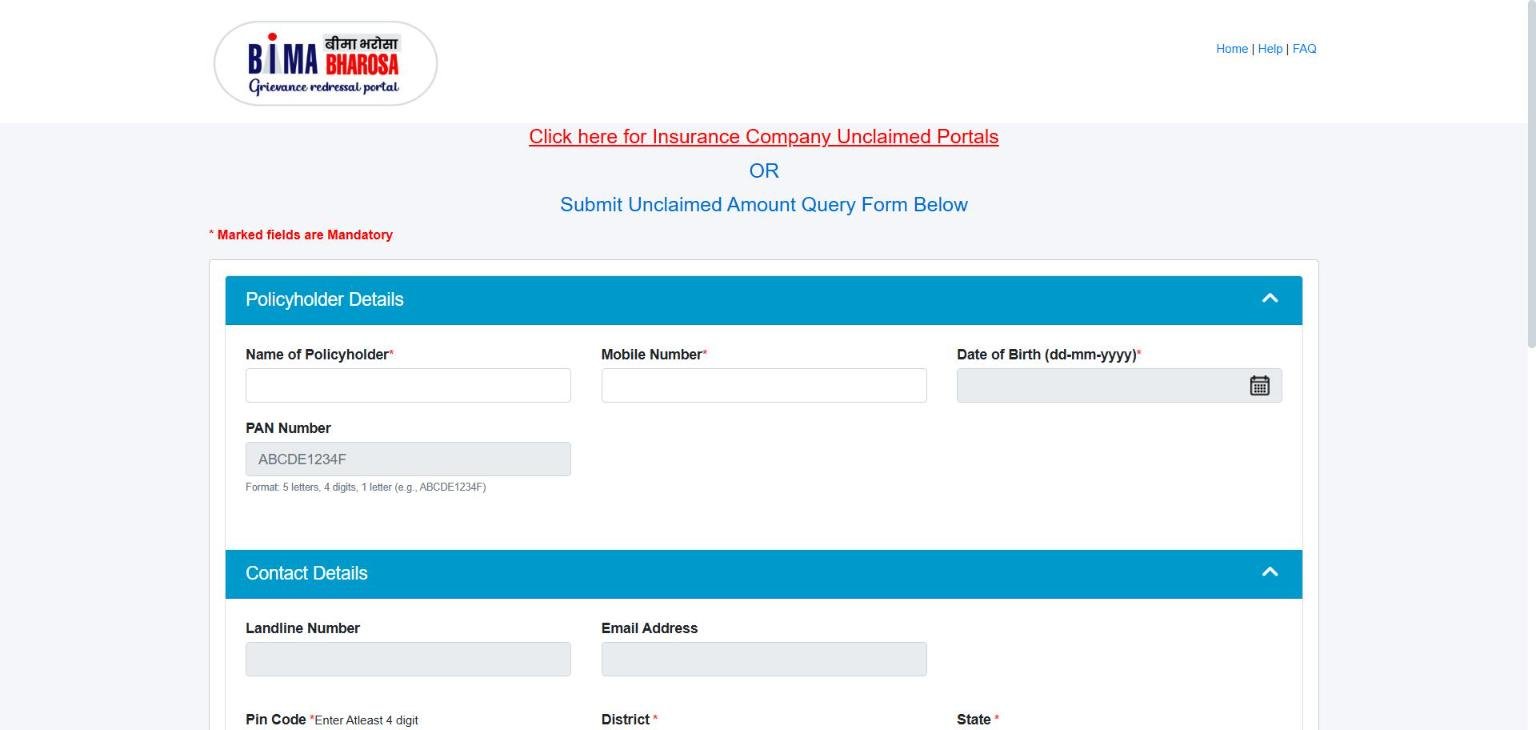
- Open bimabharosa.irdai.gov.in and click Unclaimed Amount.
- Choose Submit Unclaimed Amount Query Form.
- Fill in the policyholder’s name, mobile number and date of birth (all mandatory). PAN is optional.
- Add your contact details. Pin code, district and state are mandatory; you can also write a short note in Query Details.
- Select up to five insurance companies and enter the policy number for each. If you have more than one policy with the same insurer, separate the numbers with commas.
- Tick the consent box (your details are shared only with the insurers you chose) and click Submit. The insurers then check their records and contact you.
Bima Bharosa itself shows a warning that it never asks for payment, and that you should not scan any QR code or use any link that claims to send money to your account.
After you find a match: claiming the money
- Contact the insurer: the nearest branch, its customer care number or its claims email. Quote the policy number.
- Fill in the insurer’s claim form (for a maturity amount this is often called a discharge form).
- Submit your documents: KYC (identity and address proof, PAN), bank proof such as a cancelled cheque or a passbook copy, and the original policy bond.
- Lost the policy bond? The insurer will usually ask for an indemnity bond (a signed promise to repay the insurer if another claimant appears) instead.
- The insurer pays electronically (NEFT, RTGS or IMPS) into your bank account, along with the investment income earned on the unclaimed amount.
If the policyholder has died
If there is a nominee, the nominee claims with the death certificate, the claim form, their own KYC and bank proof. Some insurers also ask for proof of relationship or hospital records.
If there is no nominee, or the nominee has also died, the legal heirs claim. The insurer may ask for a legal heir certificate, a succession certificate, or no-objection letters from the other heirs, depending on the amount.
Our documents checklist for claiming a deceased person’s money lists everything in one place.
What if the money went to the Senior Citizens’ Welfare Fund?
Amounts unclaimed for 10 years are transferred by insurers to the Senior Citizens’ Welfare Fund (SCWF), a government fund. This happens once a year, by 1 March.
The money is not lost. You can still claim it for up to 25 years from the date it was transferred. You still apply through the insurer, which handles the claim. Only after those 25 years does the amount go to the central government for good.
Common problems and how to fix them
No policy number
The Bima Bharosa query form needs a policy number for each insurer you select. Without one, use the insurer’s own website search, which works with name and date of birth. You can also visit a branch with your ID and the policyholder’s details.
The name or date of birth doesn’t match
Old policies may have an older spelling, initials only, or a different date of birth. Try variations, for example ‘S Kumar’ instead of ‘Suresh Kumar’.
The insurer is not responding or keeps delaying
- Write to the insurer’s Grievance Redressal Officer. Contact details are on the insurer’s website.
- If there is no reply, or you are not satisfied, register a complaint on Bima Bharosa. The portal says complaints are attended to within 14 days. You can also call IRDAI’s toll-free numbers 155255 or 1800 4254 732.
- If the insurer rejects your complaint or does not reply within 30 days, you can go to the Insurance Ombudsman. It is free and you do not need a lawyer.
Watch out for scams
Searching and claiming are free. Fraudsters call pretending to be from IRDAI or an insurer, promising to ‘release’ a lapsed policy’s money if you pay a ‘processing fee’, ‘GST’ or ‘tax’. IRDAI does not sell policies or collect money from policyholders. Never pay to receive your own money, never scan a QR code to ‘receive’ a payment, and never share an OTP. If you are targeted, report it at cybercrime.gov.in or call 1930.
What to do next
- Not sure which insurer? Send one query to up to five insurers through Bima Bharosa (Option 2 above).
- Claiming for a family member who has died? Documents checklist: get these papers first
- They may also have had bank deposits or PF. Search unclaimed bank deposits on UDGAM and check PF claims by family
- Want to check everything at once? Use the “Where could my money be?” finder.
Frequently asked questions
Is there one website that searches all insurers?
Not a single combined database. Bima Bharosa forwards one query to up to five insurers at a time, and lists every insurer’s own unclaimed amount page. The government’s common portal, unclaimedassetsportal.in, links to these as well.
Is there a deadline to claim?
In practice, no. The money stays with the insurer for 10 years and can then be claimed from the Senior Citizens’ Welfare Fund for another 25 years.
Will I get interest?
Insurers must invest unclaimed amounts and pay the investment income earned on them along with the original amount when you claim.
Do I need an agent or a lawyer?
No. You can search and claim yourself, for free. A lawyer is only needed if there is a dispute between heirs.
Official links
- IRDAI Bima Bharosa (unclaimed amount query and complaints): bimabharosa.irdai.gov.in
- List of every insurer’s unclaimed amount page: Bima Bharosa insurer list
- LIC unclaimed amounts: licindia.in
- Insurance Ombudsman: cioins.co.in
- IRDAI toll-free helpline: 155255 or 1800 4254 732
- All official portals in one place: Official portals
Last checked: 19 October 2026. Rules and portals change. If something here no longer matches the portal, please tell us.
Related guides
- Documents checklist for claiming a deceased person’s money
- How to claim a deceased parent’s bank account money
- How to check unclaimed bank deposits on RBI’s UDGAM portal
- How to find and claim money from an old PF account
- How to use the government’s Unclaimed Assets Portal (unclaimedassetsportal.in)
- See all guides
About this guide: Written by the Unclaimed Now Editorial Team from IRDAI’s rules on unclaimed amounts of policyholders and the Bima Bharosa portal. Unclaimed Now is an independent guide, not a government website. This is general information, not legal or financial advice. How we write our guides.